Bugsmirror Blogs
Explore expert insights, comprehensive tutorials, and cutting-edge updates in Security and Technology.
Security Blogs
7 mins readWhat Is Jailbreak Detection in Mobile App Security?
Jailbreak detection is a critical mobile app security mechanism that identifies compromised devices to prevent data breaches, reverse engineering, and runtime attacks, ensuring secure app execution.
Mahima SoniAugust 6, 2026
.webp)
Security Blogs
7 mins readHow to Prevent Reverse Engineering in Android and iOS Mobile Apps
App repackaging and reverse engineering allow attackers to modify apps, steal data, and clone features. This blog explains how code encryption and app shielding protect mobile applications from tampering and IP theft.
Mahima SoniAugust 5, 2026
Security Blogs
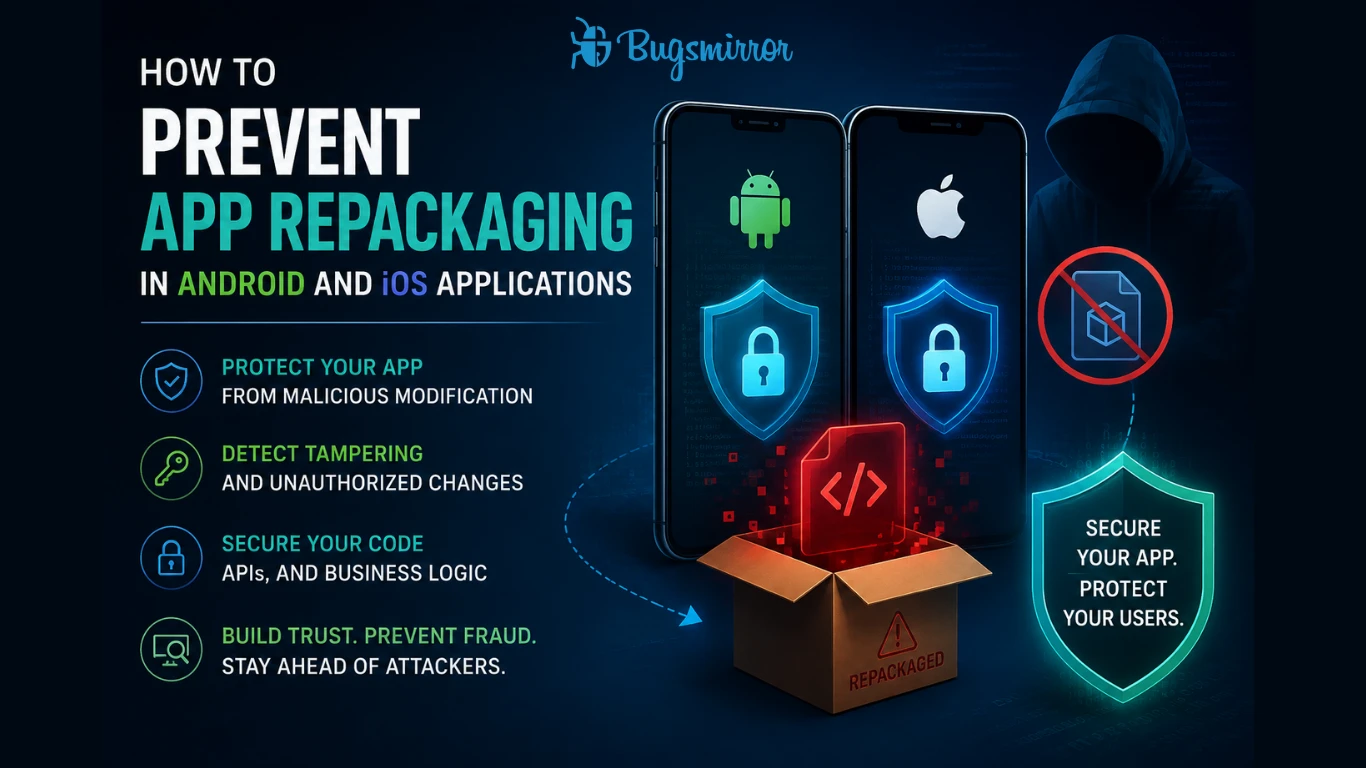
6 mins readHow to Prevent App Repackaging in Android and iOS Applications
App repackaging is a critical mobile app security threat where attackers modify and redistribute legitimate apps to inject malicious code. This can lead to fraud, data theft, and brand damage, making runtime protection and tamper detection essential for Android and iOS applications.
Mahima SoniAugust 4, 2026
Security Blogs
5 mins readHow Bugsmirror MASST Aligns With OWASP MASVS?
OWASP provides globally recognized standards for strengthening mobile app security. Its MASVS framework and Top 10 Mobile Application Security Risks outline the core controls every Android and iOS app must implement to stay protected from real-world threats. This blog introduces MASVS, explains the Top 10 risks, and shows how Bugsmirror MASST aligns with each MASVS control group—covering secure storage, cryptography, authentication, network safety, platform interaction, privacy, and protection against reverse engineering.
Vivek TanwaniNovember 18, 2025

Security Blogs
3 mins readHow Do Runtime Security Threats Impact Businesses?
In today’s digital-first world, companies across various sectors rely heavily on mobile applications to deliver seamless, on-demand products and services to customers. But the Runtime Security Threats associated with mobile apps make them a vulnerable option, especially in industries where sensitive information is involved.
Vivek TanwaniNovember 14, 2024
Security Blogs
4 mins readSecurity Inclusion - We Aim To Make Each Company Secure
In today’s digital landscape, mobile applications play a crucial role in business operations across industries. They not only provide businesses an easy way to connect with their clients and consumers but also provide users the ease of accessing the services and products provided by the businesses.
Vivek TanwaniOctober 28, 2024
Security Blogs
4 mins readHow To Comply With RBI Guidelines On Security Of Mobile Banking Applications And Transactions?
India is one of the largest markets of mobile banking in the world. As per the Indian Department of Financial Services, the number of financial transactions through mobile phones in India is 18,592 crore. Unified Payments Interface (UPI), a Made in India technology is ruling the world of Fintech. It’s used in India, as well as Singapore, UAE, France, Mauritius, Nepal, Bhutan, and Sri Lanka.
Vivek TanwaniOctober 24, 2024

Bugsmirror Defender
4 mins readBugsmirror Defender - Pioneering The Future Of Mobile App Security
Mobile app security has evolved over the years and is becoming more internal than external. Well, to understand the previous sentence, you need to understand in-app protection techniques such as Runtime Application Self-Protection (RASP), tamper detection, etc., that are a set of security measures embedded directly into the mobile applications to protect them from the inside. It’s a much superior way to protect mobile apps than the old-school app protection solutions. The market abounds with various products designed to safeguard apps from within, and we are thrilled to introduce Bugsmirror Defender - our revolutionary mobile app security product, addressing the growing demand for heightened mobile app security. Let’s start exploring Bugsmirror Defender.
Vivek TanwaniJanuary 23, 2024
(1)(1))
Security Blogs
6 mins readHow to Perform a Complete Mobile App Security Assessment (Step-by-Step Guide)
A complete mobile app security assessment involves evaluating the application from multiple angles, code, APIs, runtime behaviour, and infrastructure to identify vulnerabilities and mitigate risks before they can be exploited. This step-by-step guide walks you through the entire process, starting from planning and scoping to advanced security testing and runtime protection. You’ll learn how to conduct static and dynamic analysis, secure APIs, perform penetration testing, and implement runtime application self-protection (RASP). Whether you are a developer, security professional, or business owner, this guide will help you build and maintain secure mobile applications.
Mahima SoniMay 19, 2026