Document Library
Explore our in-depth case studies, white papers and guidelines to understand how we tackle complex security challenges
Verified Is Not Protected: Red Teaming an SMV Flow in a Payment App
Explore how Bugsmirror's red team bypassed SMV-based device binding in a UPI payment app, exposing gaps between mobile verification and application security.
Anatomy of a Mobile Banking App Attack: From Decompile to Transaction Fraud
This whitepaper follows one mobile banking app attack from start to finish. It shows how an attacker downloads a UPI-enabled banking app, decompiles it, finds and removes its client-side checks, and reaches a fraudulent transaction. Each stage names what the attacker does, what the bank could detect and the control that stops the chain.
Silent Mobile Verification Is Not a Fraud Prevention Solution
Silent Mobile Verification (SMV) is increasingly being used in Indian banking and payment applications for SIM-device binding and mobile-number verification. But does it actually prevent account takeover? This whitepaper by Bugsmirror Research examines the security assumptions behind SMV through an authorised assessment of a live UPI payment application with over 50 crore downloads. It explains how the tested device-binding flow was bypassed, why the verification process left the account holder without visible warning signals, and what financial institutions should reconsider when relying on SMV as a fraud-prevention control. No customer accounts or funds were affected during the assessment.
Strengthening App-Level Security Against Device-Binding Fraud in 2026
Explore how device-binding fraud occurs in mobile applications and how app-level security measures help detect binding bypass attempts, prevent unauthorised device access, and protect sensitive transactions.
Why Commercial Off-The-Shelf (COTS) RASP Solution Is Better Than A Free RASP Solution
Choosing the right RASP solution impacts your app’s runtime security, performance, and scalability. This whitepaper explains why commercial off-the-shelf (COTS) RASP solutions provide stronger protection, faster deployment, and continuous updates compared to free alternatives, making them a better choice for enterprise-grade mobile app security.

Trust API Bind: Extending Runtime Security
Trust API Bind (TAB) redefines runtime API security for mobile apps by binding every request to a verified app instance and live runtime signals. Discover how dynamic tokens and real-time validation stop API abuse, replay attacks, and fraud, unlocking a new standard of protection for fintech, banking, and payment applications.
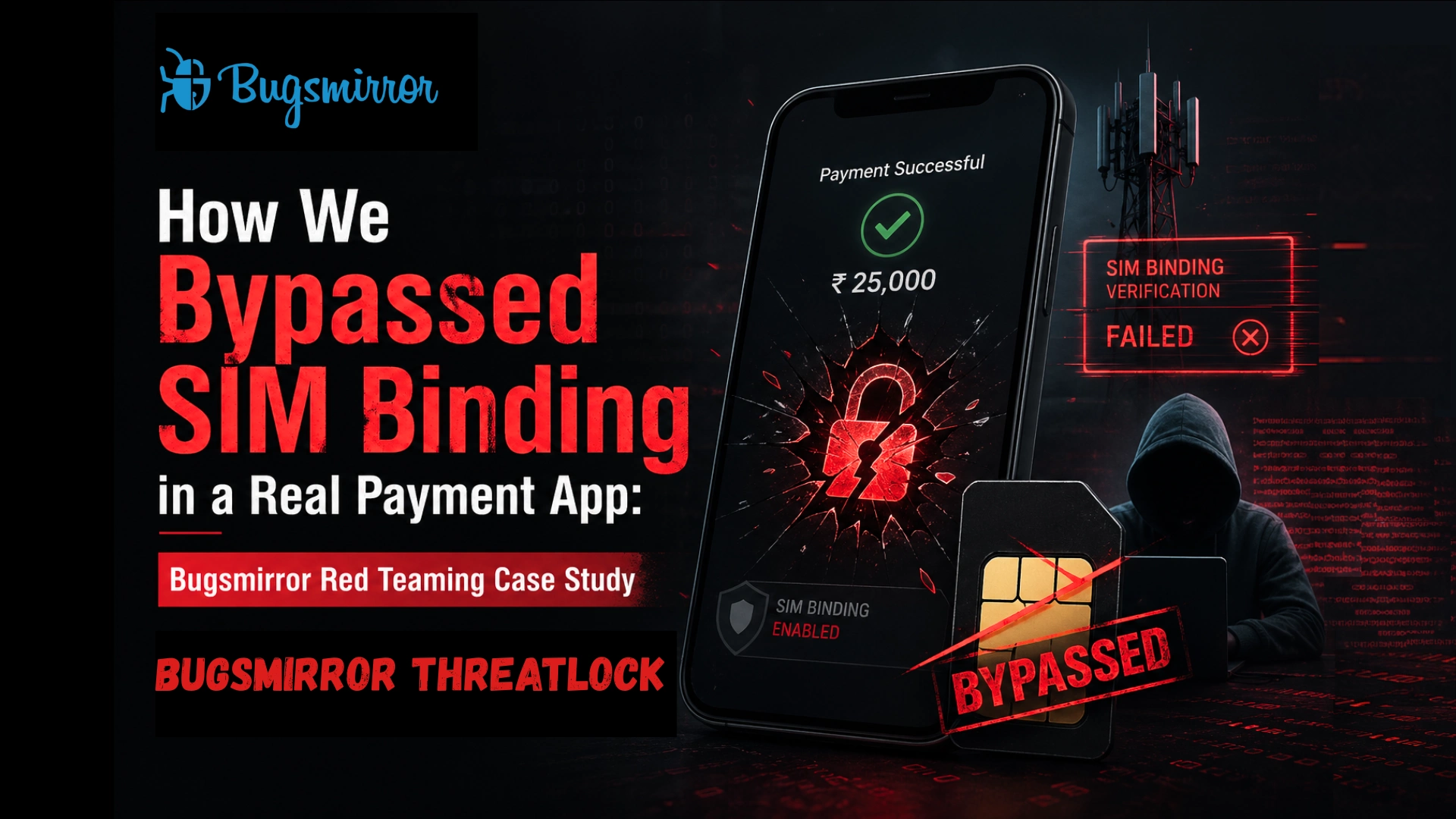
How We Bypassed SIM Binding in a Real Payment App: Bugsmirror Red Teaming Case Study
SIM binding is widely used in mobile payment and fintech apps as a core security control to ensure that only the registered SIM and device can initiate transactions. However, real-world testing shows that this mechanism is often built on assumptions that no longer hold true in modern threat environments. This case study breaks down the SIM binding process, highlights where current implementations fall short, and explains how these gaps can lead to full account takeover. It also emphasizes the need for runtime protection and stronger validation mechanisms to defend against evolving mobile threats.
Extending Runtime Security With the Cloud-Based RASP Solution (ThreatLens & OTA)
Explore how cloud-based RASP solution enhance runtime security by enabling informed decisions, faster analyses, and continuous protection.
Account takeover: Detecting realworld cyber risk in a Large-Scale UPI Payment App
A real fintech case study on detecting cyber attacks and account takeover fraud using red teaming in a UPI Payment Service Provider company with 10 crore+ users. Read how Bugsmirror was engaged to investigate an attack affecting users' money and the company's reputation.
Achieving Compliance with PCI CPoC Standards
A guide to PCI CPoC security requirements, focusing on tamper resistance, reverse-engineering protection, and securing contactless payment apps.