
Telecom Application Security
Protect telecom applications from malware, app tampering, device compromise, and runtime attacks.
Telecom apps constantly face attacks such as API abuse, recharge fraud, reverse engineering, application tampering, and business logic manipulation that can compromise application functionality and sensitive subscriber services.
Bugsmirror MASST strengthens the mobile security layer around telecom applications, helping organizations detect vulnerabilities, protect application integrity, and secure critical subscriber and service workflows.
Billions of Subscribers. One Digital Gateway to Telecom Services.
Telecom operators increasingly rely on mobile applications to deliver essential customer services. As more subscriber interactions move to mobile, these applications become high-value targets for attackers.
A compromised telecom application can expose subscriber identity, account information, service controls, payment details, and mobile number management, creating opportunities for recharge fraud and service abuse.
Secure telecom applications against threats with Bugsmirror MASST, combining security testing and runtime protection together to simplify DevSecOps process.
Every telecom app is a potential entry point to subscriber accounts and services.
The Telecom Application Attack Surface Is Expanding
API Abuse
APIs powering recharge, plan activation, offers, loyalty benefits, referrals, and customer services can be targeted to manipulate workflows, bypass controls, or perform unauthorized actions.
Recommended controls: API security testing, API abuse testing, business-logic testing, server-side validation of RASP controls, and runtime monitoring.
Rooted & Compromised Devices
Rooted devices, malicious applications, emulators, and modified environments can give attackers greater control over the application runtime and create opportunities to manipulate app behavior or access sensitive data.
Recommended controls: Device integrity checks, root/jailbreak detection, malicious application detection, environment assessment, runtime threat detection, and risk-based security responses.
Reverse Engineering
Attackers can analyze telecom applications to understand their business logic, security controls, API interactions, and sensitive implementation details, creating opportunities for further exploitation.
Recommended controls: Code hardening, application shielding, secure implementation practices, and anti-reverse-engineering mechanisms.
Hooking & Runtime Instrumentation
Attackers can use hooking and runtime instrumentation to intercept or modify application functions while a telecom app is running. This can be used to manipulate authentication, OTP handling, recharge workflows, API requests, or other sensitive application logic.
Recommended controls: Anti-hooking, anti-debugging, runtime instrumentation detection, SMS hooking and spoofing detection, application integrity validation, and runtime enforcement.
Application Tampering & Repackaging
Attackers can modify and repackage legitimate telecom applications to alter application behavior, bypass security controls, or distribute unauthorized versions that can be used to abuse telecom services.
Recommended controls: Application integrity validation, anti-tampering, repackaging detection, code protection, and runtime verification.
Application Security Assessment Gaps
Incomplete testing may leave vulnerabilities in application logic, APIs, authentication, and data handling, undetected, increasing the risk of security issues during VAPT assessment or after the application moves to production.
Recommended controls: SAST, DAST, API security testing, red teaming assessment, vulnerability remediation, runtime protection, and regression testing.
Sensitive Data Exposure
Telecom applications handle subscriber information, service details, transaction data, and other sensitive information. Weak storage or application-level controls can expose this data to unauthorized access.
Recommended controls: Secure data handling, encryption, sensitive-data protection, secure key management, application security testing, and runtime environment assessment.
Recharge & Payment Fraud
Attackers can exploit weaknesses in recharge and payment workflows to manipulate transactions, abuse promotional offers, or perform unauthorized recharge-related activities.
Recommended controls: API security testing, application integrity checks, runtime protection, and business-logic validation.
Continuous Security for Telecom Applications
Security Controls That Remain Visible Across the Application Lifecycle
VAPT Clearance
Total Protection
Mobile App Threat Monitoring & Response
Your Complete Mobile Security Stack
Everything you need to secure your applications from development to runtime.






Secure the Application. Defend Every Digital Interaction.
Empowering leading enterprises to protect their digital assets with next-generation security.



















Let's Talk Security
Fill out the form below and our security experts will reach out to you shortly.
Learn More From Our Security Blog
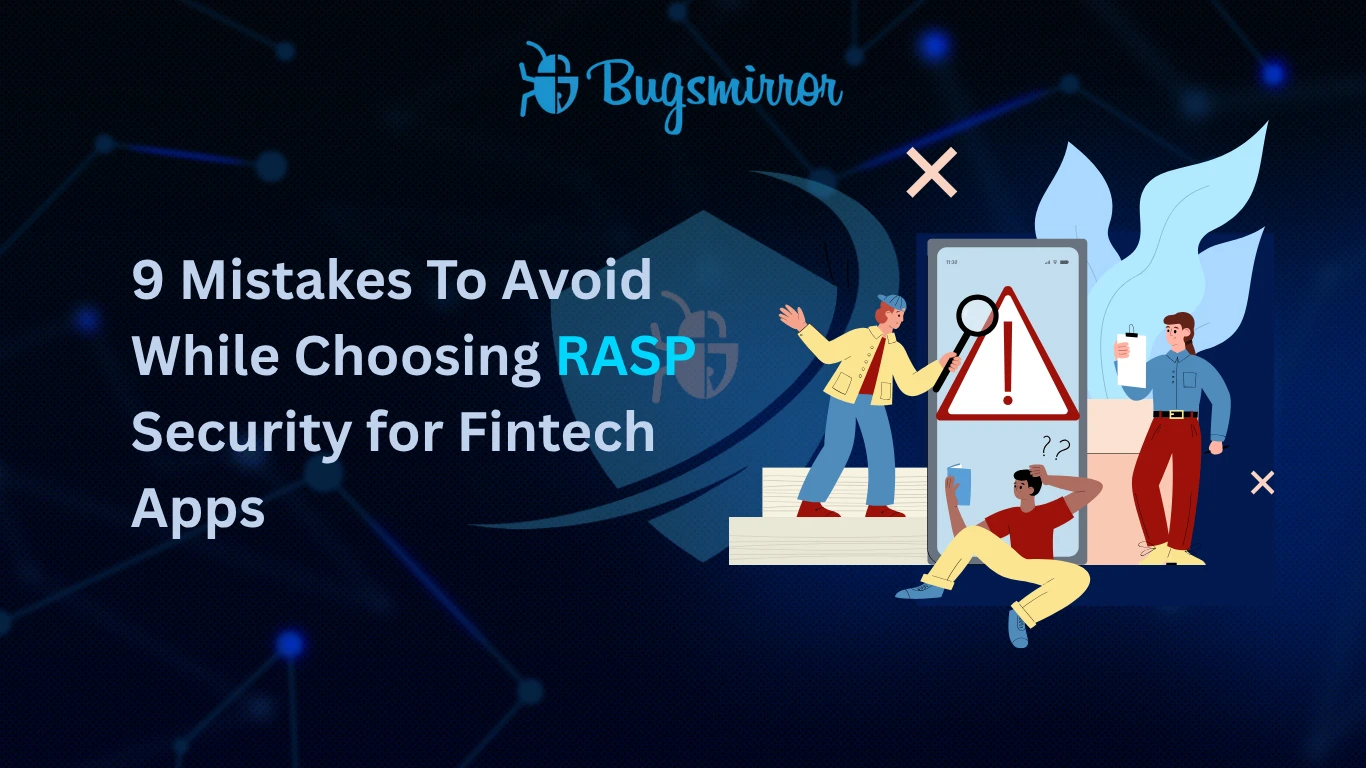
9 Mistakes To Avoid While Choosing RASP Security for Fintech Apps
Choosing the wrong RASP can expose fintech apps to fraud, API abuse, and compliance risks. Discover the most common mistakes and how solutions like Bugsmirror MASST, Defender, and TAB help secure mobile transactions effectively.

Why Real-Time Threat Visibility Matters for Mobile App Security
Mobile app security does not end after testing or deployment. Attackers continuously look for ways to bypass security controls, exploit vulnerable environments, and manipulate applications. This blog explains the importance of real-time threat visibility, how continuous threat monitoring helps security teams understand attacks in production, and how organizations can use threat intelligence to detect patterns and respond before incidents lead to fraud, data exposure, or financial loss.