How can one make self-protecting mobile apps?
Introduction
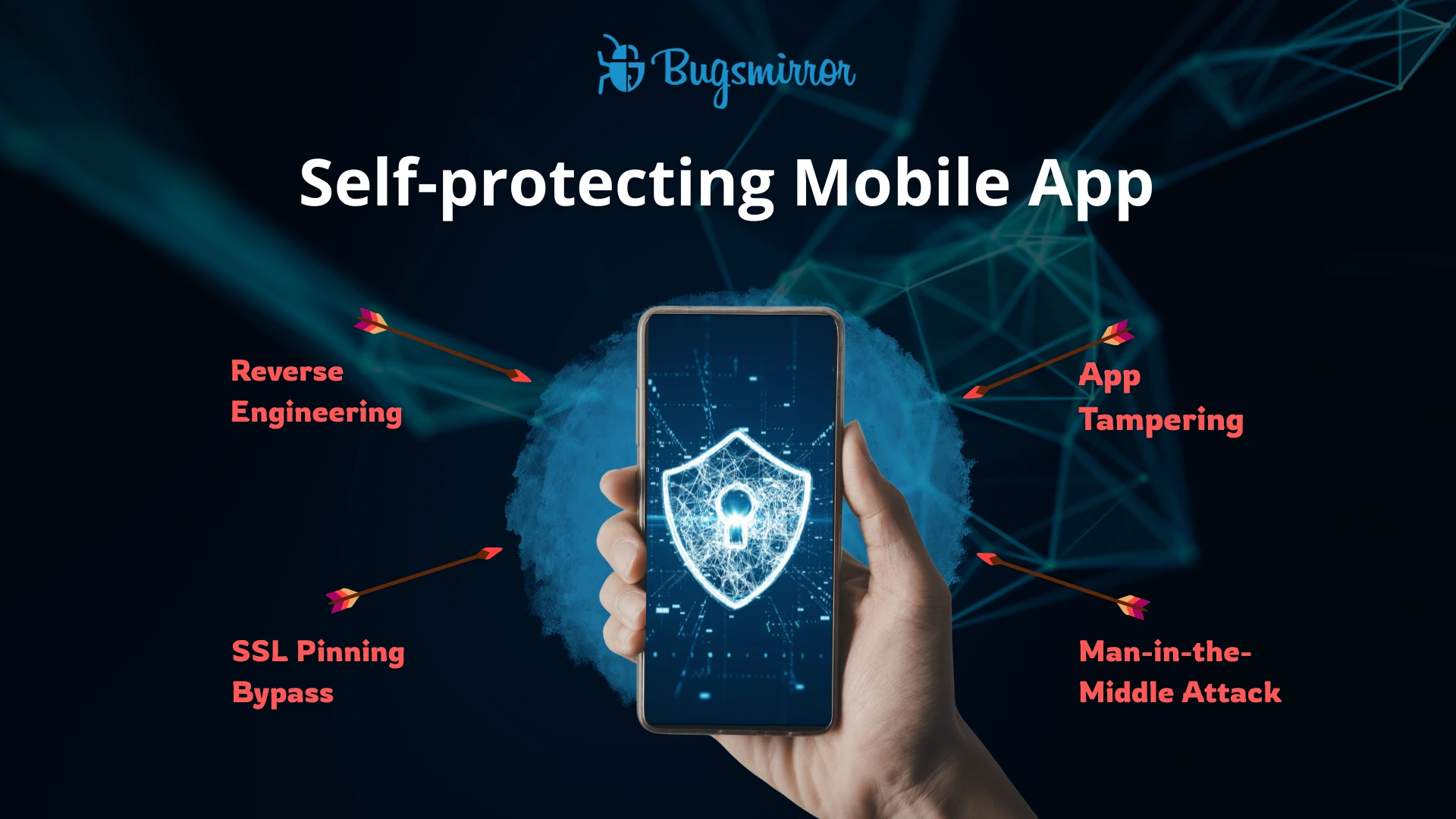
Mobile applications today operate in highly unpredictable environments. Once installed on a user’s device, the application runs outside the direct control of the development team. These devices may be rooted or jailbroken, apps can be repackaged, runtime manipulation tools may interfere with logic, and network communications may be intercepted. Such devices are not safe to run applications as they can damage apps, steal personal data, harm the app and users using the application.
Mobile apps are built with security measures such as backend validation, SSL encryption, and secure coding practices, which are essential but not sufficient in today’s evolving threat landscape. Modern threats target the application while it is running. To address this gap, organisations are increasingly moving toward building self-protecting mobile applications.
A self-protecting app is designed to monitor, detect, and respond to threats in real time, directly from within the runtime environment and without any manual intervention.
What does self-protecting mobile apps mean?
A self-protecting mobile app embeds runtime security mechanisms within itself to continuously validate its integrity and execution environment. Instead of relying solely on perimeter defences or server-side controls, the application actively checks parameters such as:
- Whether the device they are running is rooted or jailbroken.
- Whether debugging tools are attached.
- Whether the app binary has been tampered with.
- Whether it is running inside an emulator.
- Whether secure communication channels are being intercepted.
- Whether screen overlay or screen capture attacks are occurring.
Self-protecting apps are created with built-in security mechanisms. It does not impact their response time and user interaction, but makes it resilient against runtime threats. It detects threats and protects the app in real time. In simple terms, the app does not assume the device is safe. It verifies trust dynamically.
This approach aligns with the principle of zero-trust security at the application layer, where trust is never assumed and must be continuously validated.
How does a self-protecting app work?
A self-protecting app is one in which a security layer or SDK is embedded into the application during development. This layer becomes a part of the app runtime environment.
The process involves:
1. Environment validation
App always checks the device environment, such as:
- Root or jailbreak device.
- Presence of an emulator or simulator.
- Developer mode status.
- Untrusted app installations.
2. Integrity verification
The application validates:
- App signature.
- Binary integrity.
- Whether the code has been modified or repackaged.
3. Runtime monitoring
The app detects:
- Hooking frameworks.
- Code injection attempts.
- Screen overlay attacks.
- Keylogging or screen-reading attempts.
4. Secure communication enforcement
Mechanisms like SSL certificate pinning and man-in-the-middle detection ensure that network traffic is not intercepted or altered.
5. Automated Response
When suspicious behaviour is detected, the app can:
- Block execution.
- Log the event.
- Alert backend systems.
- Restrict sensitive actions.
Best practices for self-protecting mobile apps
Building a self-protecting mobile app requires a layered and disciplined approach. There are some best practices to follow:
1. Secure coding practices:
When building the app, coding practices must be secure and checked for security bugs at every stage. SAST, DAST, and IAST testing are necessary after every update. To get an easy testing solution across every stage of DevSecOps, you can opt for Bugsmirror MASST, which provides testing tools for every development phase on a single unified platform. Security controls should be integrated during the development phase rather than after deployment of the app.
Apart from automated testing, manual testing and red team security testing are equally important. They help identify whether the mobile app can withstand real-world attack strategies that an attacker would actually use.
2. Implement runtime application self-protection (RASP) early:
RASP is a security technology that integrates directly into an application to provide real-time protection from runtime attacks during app execution. Unlike traditional security tools that operate at the network or infrastructure level, RASP works from inside the application. It monitors application behaviour, detects abnormal activity, and can respond automatically when a threat is identified.
In mobile environments, RASP capabilities typically include:
- Root and jailbreak detection.
- Anti-debugging mechanisms.
- Anti-hooking detection.
- Code integrity validation.
- SSL pinning enforcement.
- App tampering detection.
- Protection against code injection.
- Application restrictions on compromised devices.
- Protect Against App Repackaging.
By embedding these controls within the application, RASP ensures that protection remains active even if the device itself is compromised. Bugsmirror Defender (a RASP solution) implements such runtime validation and monitoring capabilities with minimal integration effort, enabling organisations to enhance application resilience without redesigning core logic.
3. Enforce code obfuscation and hardening:
Code obfuscation is required to prevent reverse engineering and protect the intellectual property of an application. But basic code obfuscation is not sufficient; thus, beyond obfuscation, Bugsmirror Shield (an anti-reverse engineering tool) implements advanced technologies such as transformation, encryption, dynamic key protection, and decryption at runtime, which reduces the chances of reverse engineering and decompilation.
What are the benefits of self-protecting mobile apps?
Organisations that implement runtime self-protection benefit in several ways:
- Runtime protection supports security compliance requirements in fintech, healthcare, and enterprise sectors.
- Blocking emulators, rooted devices, and runtime manipulation reduces exploitation vectors on their app.
- Protection of Intellectual Property by code obfuscation and anti-reverse engineering measures.
- Enhanced Data Protection by securing storage and encrypted communication.
- Customers are more confident using apps that actively protect their data and privacy.
- Runtime monitoring provides insights into how attackers attempt to manipulate the application.
- These benefits are especially critical for financial apps, healthtech, enterprise mobility solutions, automotive systems, and consumer platforms handling sensitive information.
Emerging technologies in self-protecting mobile apps
Real-time threat intelligence and visibility: The Threat Dashboard provides real-time threat visibility, showing threat types, locations, and categories.
Whitelisting: With threat intelligence, it is also important to whitelist genuine users to maintain the user base while protecting apps from attackers.
Moving towards a Zero-Trust Approach: Modern mobile app security solutions, such as those provided by Bugsmirror MASST, are increasingly combining automation with security research to address both known and emerging attack vectors and help in approaching a zero-trust policy in security.
Conclusion
Mobile applications can no longer rely solely on perimeter defences or backend validation. The device environment is inherently untrusted, and runtime attacks are increasingly sophisticated. Self-protecting mobile apps embed security within the application itself, enabling real-time detection and response to tampering, reverse engineering, and runtime manipulation.
By integrating runtime protection, enforcing comprehensive app shielding, and adopting zero-trust principles, organisations can significantly strengthen their mobile security posture.
Experience how Bugsmirror Defender integrates and protects mobile apps seamlessly with a 14-day Free Trial.
Share this article
Help others discover this content
Don’t give fraud a way in. Secure every layer of your mobile app.
100M+
Users Protected
100+
Apps Secured
1000+
Apps Hardened